A One-Day Checklist for Anglo-Saxon Sites in Winchester
Winchester is compact enough to cross on foot in twenty minutes, which is exactly why a day among its Anglo-Saxon remains can slip away on the High Street. The city that Alfred the Great made his capital, and where Æthelwold drove the tenth-century monastic reform, packed its most important buildings into a space you could throw a stone across: the Old Minster, the New Minster and the Nunnaminster stood within a few hundred yards of one another. This checklist keeps the day in a sensible order, with the timings and access notes that matter.
Getting your bearings before you walk
Saxon Winchester is three religious houses plus a bishop's seat, and once you know that, the day organises itself. The Old Minster — the church of the West Saxon kings — stood just north of the present cathedral. The New Minster was founded beside it around 901 and moved to Hyde a couple of centuries later. The Nunnaminster, founded by Alfred's widow Ealhswith, sat to the west. Wolvesey, the bishop's palace, lies south-east by the river.
Everything below is within a mile of the statue of Alfred at the bottom of the High Street. Wear shoes you can walk in on cobbles: the close is uneven, and the riverside path to Hyde can be muddy after rain.
Start at the Alfred statue on The Broadway
The bronze Alfred, sword pointing down, gazing up the High Street, was unveiled in 1901 — Victorian hero-worship rather than a Saxon survival. Treat it as a waypoint anyway. It puts you at the foot of the city, facing the direction that matters, and it costs you five minutes.
Then walk up the High Street and look at the street pattern as much as the shopfronts. The broad, straight High Street and its parallel lanes broadly follow the grid laid out when Winchester was refortified as a burh in the late ninth century. You are walking through the plan, not merely past it. Ten minutes brings you to the cathedral gates.
Winchester Cathedral: the Old Minster and its bones
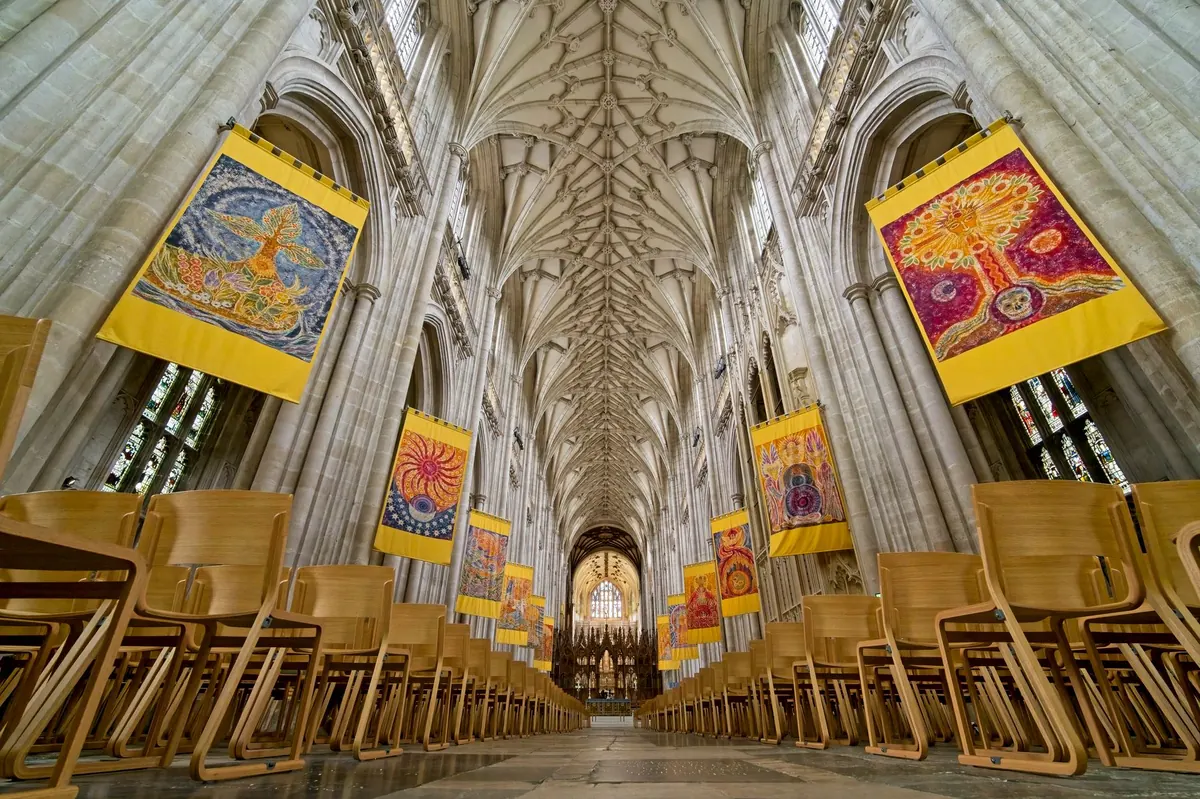
Budget ninety minutes here, and go early; the nave fills from late morning. Two things to look for before anything else.
First, the outline of the Old Minster, marked in the lawn on the north side of the cathedral. It is easy to walk past, and it is the most important thing in the city. The Old Minster was founded around 648 by King Cenwalh of Wessex and became the burial place and ceremonial church of the West Saxon dynasty. St Swithun, bishop of Winchester, was buried outside its west door in 862, and the miracles reported at his tomb turned the church into a pilgrimage site. The building was demolished from the 1090s to make way for the Norman cathedral you see now, so that marked footprint is all that survives above ground.
Second, the mortuary chests, set on the screen above the choir. They hold bones attributed to Saxon and early Norman kings and bishops — Cnut and Emma among them — rearranged and reburied more than once after Civil War soldiers broke them open and scattered the contents. Behind the high altar, a slab marks the site of St Swithun's shrine, destroyed in 1538.
If you want the tenth-century reform captured in one place, this is it: Æthelwold, bishop from 963, rebuilt monastic life here, and from Winchester the reform spread across England.
Round the close: Nunnaminster and Wolvesey
Leave by the cathedral's north side and you are standing in the three-minster landscape. Behind the buildings to the west lay the Nunnaminster, founded around 900 by Ealhswith, Alfred's widow. Almost nothing of it stands above ground, but a short detour through Abbey Gardens puts you on the spot and completes the picture.
Then head south-east, past the college, to Wolvesey Castle. The ruins are mostly the work of Bishop Henry of Blois in the twelfth century, but the bishops of Winchester had their seat here in the Saxon period too, hard against the old cathedral precinct. Entry is free and the site is managed by English Heritage; opening hours are seasonal, so check before you set out. The ground is grassy and uneven underfoot.
The City Museum and the objects
Winchester's City Museum, in the Square, fills the gaps that ruins cannot: pottery, coins, jewellery and grave goods from the city's Saxon cemeteries, plus displays on the burh and its streets. Forty-five minutes is enough for the archaeology galleries, and it makes a sensible wet-weather substitute if you need to reshuffle the day. Check the current opening days and admission charges before travelling, as both vary through the year.
Hyde Abbey: the walk north
This is the part most day visitors skip, and it earns the twenty-five-minute walk. Follow the river north from the centre, past the City Mill, and you come to Hyde.
The New Minster, founded beside the Old Minster in the early tenth century, was moved here in 1110, and with it the remains of Alfred, his son Edward the Elder and his father Æthelwulf, reburied before the high altar. The abbey was dissolved in 1539, the site was built over, and the graves were lost. Eighteenth-century digging and later building work muddled the story further, and twentieth-century excavations failed to find the burials.
What you can see now: Hyde Abbey Garden, a public garden that traces the footprint of the abbey church, the fifteenth-century abbey gateway on King Alfred Place, and St Bartholomew's, Hyde, a Norman church built at the abbey gate. It is free, quiet, and a good place to end the day.
Timing, tickets and access
A workable order:
- 9.15am — Alfred statue, then walk up the High Street.
- 9.30am — cathedral: Old Minster outline first, then the mortuary chests and St Swithun's site.
- 11.15am — Nunnaminster site and Abbey Gardens.
- 11.45am — Wolvesey Castle.
- 12.45pm — lunch in the city centre.
- 2pm — City Museum.
- 3pm — riverside walk to Hyde Abbey Garden, the gateway and St Bartholomew's.
- 4.30pm — back along the river, or a drink by the Weirs if the weather holds.
The cathedral charges admission to visitors, while attending a service is free; parts of the building close during services, especially on Sunday mornings, so check the day's times before you travel. Wolvesey is free, and Hyde Abbey Garden is free and open daily. Weekdays outside school holidays are calmest.
The cathedral has step-free routes at its main entrances, but the close is cobbled with kerbs, and the riverside path to Hyde is unsurfaced and can flood after heavy rain. If you have access needs, contact the venues directly for current arrangements rather than relying on what you read online.
Photo: Theo Felten / Pexels